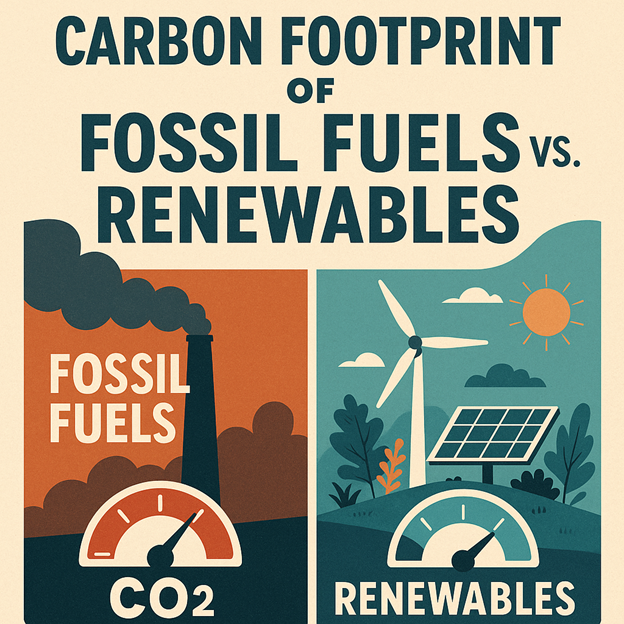
We hear the term carbon footprint a lot, but what does it really mean in the context of electricity? Put simply, your energy source has a massive impact on the amount of carbon dioxide (CO₂) released into the atmosphere. And depending on whether your power comes from coal, natural gas, wind, or solar, your footprint could vary by orders of magnitude.
So, how do fossil fuels and renewable energy sources stack up in terms of emissions? Let’s break it down.
The Carbon Cost of Fossil Fuels
Fossil fuels, like coal, oil, and natural gas, are the world’s largest contributors to greenhouse gas emissions. When burned for electricity, they release carbon dioxide, methane, and other harmful pollutants into the atmosphere.
Here’s what that looks like in numbers:
Over their full life cycle (building, fueling, running and decommissioning), coal plants emit roughly 1,000 grams of CO₂-equivalent per kWh and natural gas plants roughly 400–500 grams, while wind, solar and hydropower typically emit under 50 grams, mostly from manufacturing and construction (National Laboratory of the Rockies, formerly NREL).
Generating electricity is the largest source of energy-related CO₂ worldwide (IEA). It’s not just outdated — it’s dangerous for both public health and planetary stability.
The Carbon Footprint of Renewables
Now let’s compare that to clean energy solutions:
- Wind power: ~11 gCO₂/kWh
- Solar PV: ~40–50 gCO₂/kWh
- Hydropower: ~24 gCO₂/kWh
- Geothermal: ~38 gCO₂/kWh
These emissions mostly come from manufacturing, construction, and maintenance, not the energy generation itself. Once installed, renewable energy systems emit little to no ongoing CO₂.
Over their lifecycle, renewables reduce emissions by 90–99% compared to fossil fuels. That’s why switching to a sustainable electricity plan can be one of the most impactful climate actions an individual or business can take.
Visualizing the Difference
A typical U.S. home uses about 10,800 kWh of electricity a year (EIA). At the national average grid emission rate, that is roughly 4 metric tons of CO₂, about the same as driving one gasoline car for a year (EPA Greenhouse Gas Equivalencies Calculator).
So What Can You Do?
- Check your current provider: Are they sourcing from renewables, or is your electricity coming from fossil fuels?
- Switch to a green energy supplier: Many providers offer 100% renewable electricity plans, especially in deregulated markets.
- Share the knowledge: Help neighbors, businesses, and communities understand the power of their choices.
Final Thoughts: Your Power Has Power
Fossil fuels have served the grid for over a century, but the carbon costs are steep — and rising. Renewable energy isn’t just a bit cleaner; it’s exponentially cleaner.
If you’re looking for a way to reduce your home or business’s carbon footprint, switching to a renewable energy provider is one of the simplest, most effective steps you can take. SmartEnergy renewable plans match 100% of your electricity use with Renewable Energy Certificates (RECs) from renewable sources such as wind and solar. Your utility still delivers power from the shared local grid.
🌍 Choose a power source that works for you — and the planet.
👉 Compare SmartEnergy’s clean electricity plans →


